RESEARCH PILLAR — 01 AI & Machine Learning  ·  High-Dimensional Tensor Reasoning

AI & ML

Machine learning, deep neural representations, and federated algorithms designed to address high-precision scientific questions and operational constraints.

Call for Projects: Submit Proposal ➔
Neural Compression on Edge Hardware
Neural Compression

Adapting large models to edge hardware with concise memory profiles

High-Performance Tensor Quantization
Quantization

Sub-millisecond inference speeds via structured tensor quantization

Traffic Classification Testbed active simulation
Normal Anomaly 0 analysed, 0 isolated
RESEARCH PILLAR — 02 Cybersecurity  ·  SCADA OT Defense & Distributed Intrusion Mesh

Cybersecurity

Machine learning for traffic flow analysis, encrypted packet anomaly identification, and industrial infrastructure defense without inspecting confidential user payloads.

Call for Projects: Submit Proposal ➔
Encrypted Network Telemetry Monitoring
Encrypted Telemetry

Statistical flow metadata profiling that detects exploits inside TLS/HTTPS

SCADA Industrial Zero-Day Defense
Zero-Day Defense

Unsupervised isolation of abnormal lateral movement in industrial SCADA

10 Gbps Wire-Speed IDS
<2ms Detection Latency
99.8% Threat Precision
Zero Data Intrusion
RESEARCH PILLAR — 03 Edge-Cloud IoT  ·  Embedded Sensor Topology

IoT & Edge

Architectures designed for devices with limited battery capacity and micro-compute resources, ensuring autonomous operations across rural agriculture and smart plants.

Call for Projects: Submit Proposal ➔
Embedded TinyML Microcontroller
TinyML

Low-energy inference models embedded directly on microcontrollers

Resilient IoT Field Mesh Telemetry
Resilient Mesh

Adaptive channel multiplexing under severe network packet degradation

<1ms Edge Latency
<10mW Node Power
500+ Sensor Nodes
99.7% Uptime
RESEARCH PILLAR — 04 Heterogeneous Data  ·  Stream Flow & Multimodal Manifold

Data & R&D

Extracting predictive signals from heterogeneous data: network traffic, physical sensors, time series, and industrial operational metrics.

Call for Projects: Submit Proposal ➔
Automated Manufacturing Analytics
Industrial Analytics

Predictive maintenance algorithms deployed on manufacturing lines

Academic Science Lab & Publications
Scientific Writing

End-to-end guidance from research hypothesis to Q1 journal acceptance

YaneCode Lab

Research & Innovation — Key Performance Indicators

9
Scientific Publications
3
Indexed Journal Articles
12
Researchers & Students
1
Patent (Brevet d'invention)
2
R&D Projects
4
Partner Organizations

Research Pillars

Four areas of expertise, one lab

Every project combines these skills: a model only has value if it holds up on real data and inside a secure system.

Pillar 01 · AI & ML

Artificial intelligence

Machine and deep learning, federated learning, AI agents: models built to answer a precise research question.

Federated Learning Quantization Neural Agents
Pillar 02 · IoT & Edge

Internet of Things

IoT traffic, quality of service, embedded intelligence: architectures designed for devices with limited energy and computing power.

TinyML Mesh Protocols Low-Power QoS
Pillar 03 · Cybersecurity

Cybersecurity

Intrusion detection, traffic analysis, data protection: AI as a way to strengthen system security.

Encrypted Telemetry Zero-Day IDS SCADA Hardening
Pillar 04 · Data Science

Data

Collecting, preparing and analysing heterogeneous data: network traffic, sensors, time series, business data.

Time Series Digital Twins Anomaly Isolation

Research Infrastructure

From data to results, on one infrastructure

The research infrastructure brings together execution, simulation and test environments. The same models handle traffic and data of different kinds.

Inputs
IoT traffic
Network traffic
Sensors and time series
Business data
YaneCode Lab AI models trained, simulated, tested
Outputs
Anomaly detection
Prediction
Optimisation
Decision support
ENV 01 · COMPUTE
Execution
Train and evaluate models in a controlled, high-throughput environment.
ENV 02 · SIMULATION
Simulation
Reproduce networks and traffic scenarios before any deployment.
ENV 03 · BENCHMARK
Testing
Compare an approach with baseline methods under identical experimental conditions.

Scientific Writing Support

High-quality papers, from research question to acceptance

Scientific writing support covers both publication routes, with a strategy set from the start of the work.

TRACK A · PROCEEDINGS

International conferences

Papers ready to submit, in the format and by the deadline of the target conference, through to the presentation.

TRACK B · PERIODICALS

High-quality journals

Journal articles aimed at indexed journals, including Q1 journals, with IEEE, ACM and Springer among the target publishers.

  1. PHASE 01 · SCOPE

    Topic and research question

    State a clear research question and an identifiable contribution.

  2. PHASE 02 · SOTA

    State of the art and literature review

    Position the work against existing publications and seminal benchmarks.

  3. PHASE 03 · VALIDATION

    Methodology and experiments

    Design the experiments, benchmarks and validation of results.

  4. PHASE 04 · COMPOSITION

    Writing the paper

    Structure and write to the requirements of the conference or journal.

  5. PHASE 05 · STRATEGY

    Submission strategy

    Choose the conference or journal best suited to the contribution.

  6. PHASE 06 · PEER REVIEW

    Responses to reviewers

    Prepare revisions and answer the reports point by point.

Application Domains

The potential in each sector

The same building blocks (AI, IoT, cybersecurity, data) open different research and application paths in each sector.

SECTOR 01

Education

  • Virtual labs and simulated practical work
  • Adaptive learning
  • Learning-path analytics
SECTOR 02

e-Health

  • Remote monitoring with connected devices
  • Clinical decision support
  • Privacy of medical data
SECTOR 03

Industry 4.0

  • Predictive maintenance
  • Digital twins
  • Security of industrial networks
SECTOR 04

Logistics

  • Real-time flow tracking
  • Route and stock optimisation
  • Demand forecasting
SECTOR 05

Agriculture

  • Crop sensors and imaging
  • Water and soil management
  • Yield forecasting
SECTOR 06

Finance

  • Fraud detection
  • Risk analysis
  • Transaction security

Research & Industry

Where researchers and industry work together

Research creates value when topics come from real needs and results go back to the people who raised them.

ACADEMIA & PHDs

For researchers

  • An infrastructure to run experiments
  • Research questions drawn from the field
  • Support all the way to publication
ENTERPRISE & PILOT DEPLOYMENT

For industry

  • Expertise in AI, IoT, cybersecurity and data
  • Prototypes tested before deployment
  • Solutions built together with your teams

Collaborations & Network

Our Collaborators

Academic institutions and industrial leaders collaborating with YaneCode Lab.

  • AGRI-FOOD & COOPERATIVECOPAGAgri-food and cooperative innovation

  • INDUSTRY & MININGOCPIndustry, chemistry and sustainable innovation

  • AGRO-INDUSTRYCosumarAgro-industry and process optimisation

  • AUTOMOTIVE R&DRenault GroupAutomotive, engineering and R&D

Scientific Intake & Collaboration Hub

Get in Touch with Scientific Direction

Direct exchange with our scientific leadership to frame high-impact research challenges, benchmark experimental architectures, or co-supervise doctoral and industrial studies.

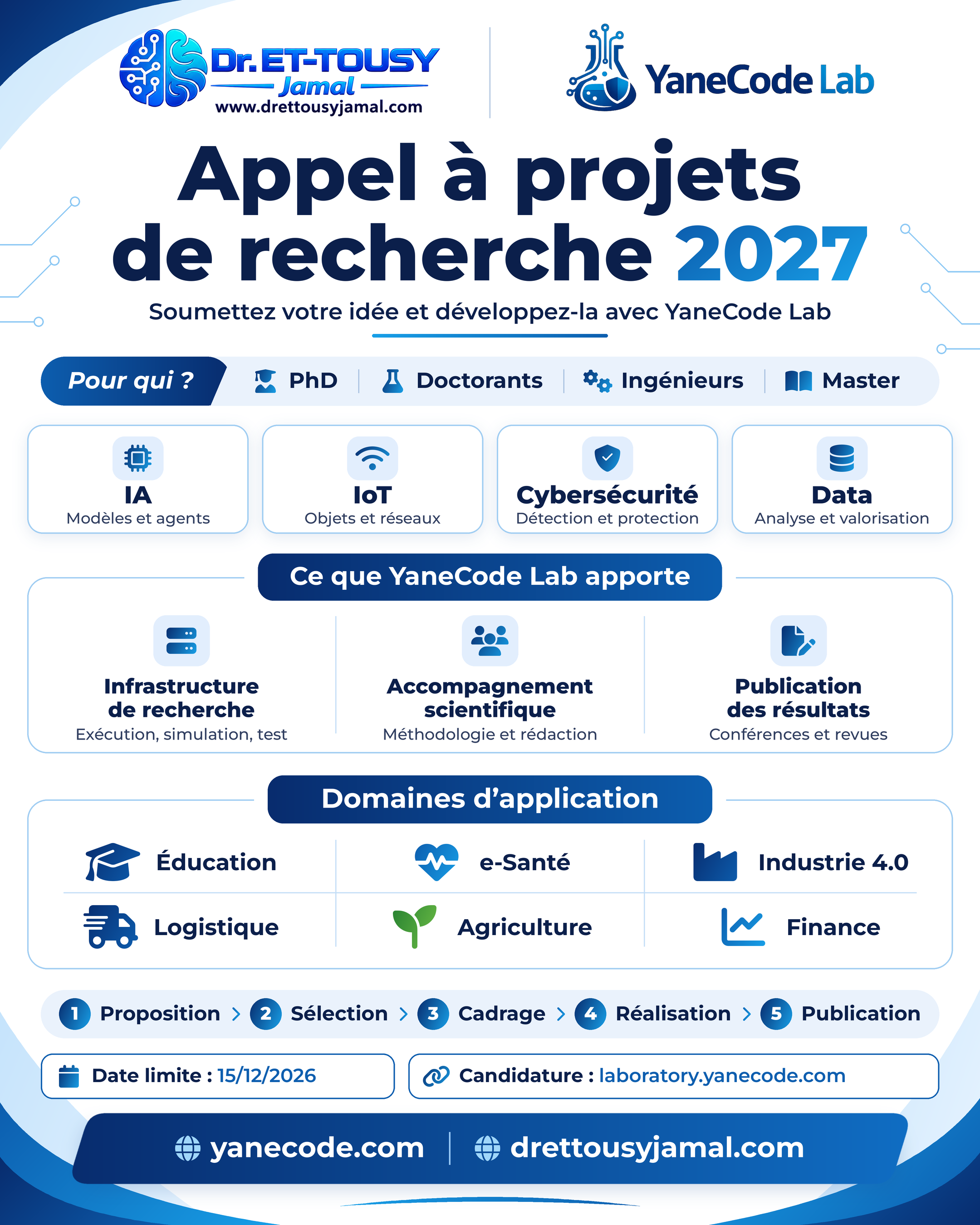
YaneCode Lab — Appel à Projets 2026-2027

Research Proposal Submission Form

Complete the criteria below and upload your presentation for review by the laboratory scientific committee.

First and Last Name of candidate / primary researcher
For committee communications and interview scheduling
With country dialing code (e.g. +212)
Priority laboratory research tracks (click to select):
Distributed AI SCADA Cybersecurity Edge-Cloud IoT Federated Learning Anomaly Detection
Working title of thesis, funded grant, or collaborative journal study.
Upload a presentation outlining the following 6 pillars:
Research background & problem statement
Objectives and expected outcomes
Proposed methodology & technical approach
Required resources (hardware, datasets)
Expected support & collaboration needs
Project timeline & deliverables
Accepted Format: PDF only Max: 30 MB
Click to browse or drag & drop your PDF proposal PDF format (Slide presentation or synthesis memo, max 30 MB)
Encrypted & confidential dossier transmission
Dr.-Ing. Jamal ET-TOUSY

Dr.-Ing. Jamal ET-TOUSY

Ph.D. in AI & Cybersecurity · Scientific Director YaneCode Lab & CED UCA

Leading applied experimentation across distributed neural networks, edge computing constraints, and critical infrastructure cybersecurity defense models.

Collaborative Research & Project Tracks
Diagnostic Flash (30 min) Rapid problem statement scoping, thesis bottleneck identification, and initial algorithm review.
Strategic Review (60 min) High-impact journal paper benchmark (IEEE, Springer, ACM) & industrial R&D roadmap alignment.
Ph.D. & Research Fellowships Funded thesis co-direction, compute resources access (GPU clusters, IoT testbeds), and publication support.
Scientific Committee Evaluation Protocol
Formal Peer Review & Academic Protocol

Each research proposal dossier is evaluated against international standards (IEEE/ACM/Springer benchmarks) with feedback returned directly by the scientific direction within 48 to 72 hours.

48–72h Turnaround Peer Assessment 100% Confidential